Categories
Blog

10 steps in plastic mold design

Accept the assignment

The task of molding plastic parts is usually proposed by the designer of the part, and its content is as follows:
1. Drawings of conventionally produced parts that have been inspected and signed, and indicate the grade and transparency of the plastic.
2. Specifications or technical requirements of plastic parts.
3. Production output.
4. Samples of plastic parts.
Usually, mold design tasks are presented by plastic craftsmen based on plastic molding tasks. Mold designers design molds based on the task of molding plastic and mold design.
Collect and organize data on product design, molding process, molding equipment, machining and special processing for designing molds.
1.Extract the drawings of plastic parts, understand the use of the parts, analyze the technical requirements of the plastic parts, such as manufacturability and dimensional accuracy.
For example, what are the requirements for the appearance, color transparency and performance of plastic parts, whether the geometry, slope and insert of the plastic parts are reasonable, the degree of molding defects such as welding defects, shrinkage holes, and whether there is post-coating , Such as assembly, plating, gluing, drilling, etc. Select the size with the highest dimensional accuracy of the plastic part to be analyzed, and see if the estimated forming tolerance is lower than the plastic part’s tolerance, and whether it can form a satisfactory plastic part. In addition, it is necessary to understand the plasticization and molding process parameters of plastics.
2. Extract process data and analyze whether the molding methods, equipment models, material specifications, mold structure types and other requirements listed in the process task book are appropriate and can be implemented.
The molding material should meet the strength requirements of plastic parts, and have good fluidity, uniformity, isotropy and thermal stability. According to the use of plastic parts, the molding material should meet the requirements of dyeing, metal plating conditions, decorative properties, necessary elasticity and plasticity, transparency or opposite reflectivity, adhesion or solderability.
3. Determine the molding method-use direct compression, casting or injection molding.
4. Select molding equipment
The mold is made according to the type of molding equipment, so you must be familiar with the performance, specifications and characteristics of various molding equipment. For example, for an injection machine, you should understand the following in terms of specifications: injection volume, clamping pressure, injection pressure, mold installation size, ejector and size, nozzle hole diameter and nozzle ball radius, gate sleeve positioning ring size, mold The maximum and minimum thickness, stroke of the template, etc. For more information, please refer to the relevant parameters.
A preliminary estimate of the mold size is required to determine if the mold can be installed and used on the selected injection molding machine.
5. Specific structural scheme
(1) Determine the mold type
Such as compression mold (open, semi-closed, closed), casting mold, injection mold, etc.
(2) Determine the main structure of the mold type
Choosing the ideal mold structure is to determine the necessary molding equipment and the ideal number of cavities. Under absolutely reliable conditions, the work of the mold itself can meet the technical and production economic requirements of plastic parts. The technical requirements for plastic parts are to ensure the geometry, surface finish and dimensional accuracy of plastic parts. The economic requirement of production is to make the cost of plastic parts low, the production efficiency high, the mold can work continuously, the service life is long, and the labor is saved.
3. There are many factors that will affect the structure of the mold and the individual system of the mold. These factors are very complicated:
1. Cavity layout. According to the geometric characteristics of plastic parts, dimensional accuracy requirements, batch size, ease of mold manufacturing, mold cost, etc., determine the number of cavities and their arrangement.
2. Determine the parting surface. The parting surface should be positioned to facilitate mold processing, venting, demolding and forming operations, and the surface quality of plastic parts.
3. Determine the gating system (shape, position and size of the main flow channel, runner and gate) and the exhaust system (exhaust method, position and size of the exhaust box).
4. Select the ejection method (ejector, ejector, push plate, combined ejection), and then determine the undercut processing method and core extraction method.
5. Determine the cooling and heating method, the shape and position of the heating and cooling grooves, and the installation position of the radiator

If we can help you with your project please call us at 0086-769-82821468 or email sales@kaitomould.com.

Categories
Blog

THE DIFFERENCE BETWEEN CNC MACHINING AND 3D PRINTING

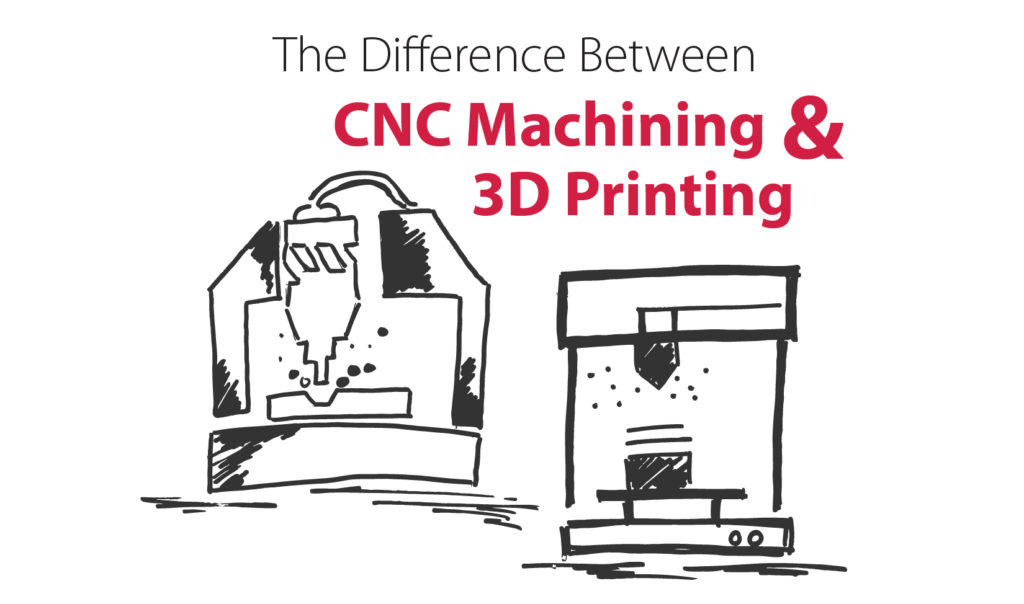
As technology advances and revolutionizes engineering and machinery, you want to know you’re using the best equipment and leading your business forward. Some of these advancements are in computer numeric control (CNC) machining and 3D printing. They both work with different materials. But which one is best for your needs?

CNC machining and 3D printing have similarities and differences, and each has unique benefits. They have varying circumstances where you would want to use them regarding cost and availability. Breaking down each manufacturing style will help you pick the best method for you and your business.

Their main differences occur in productionwastescalematerial availability and size of the parts.

SIMILARITIES BETWEEN CNC AND ADDITIVE MANUFACTURING (3D PRINTING)

CNC machining and additive manufacturing are both computer-controlled solutions to making products out of a given material. They’re both machines at the forefront of building technology safely and efficiently.

As machinists and engineers want to build a prototype, a part or a custom product, they can turn to one of these machines to do the job for them. As long as the machines have the design, you don’t have to worry about human error because the machines are automated. While this doesn’t mean issues don’t arise, there’s more consistency with production and less chance of injury.

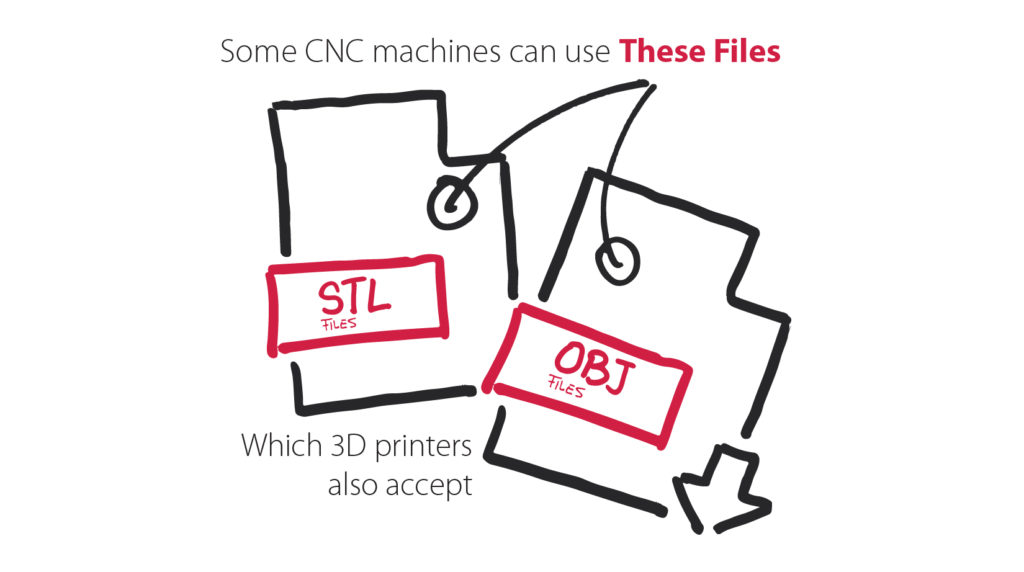
There is some overlap with these two manufacturing methods. Some CNC machines can use STL and OBJ files, which 3D printers also accept.

CNC machinery is older than 3D printing and still has a stronger foothold in manufacturing. The form started in the 1940s and had molded to fit into the industry up to the present. 3D printing came along in 1986. It’s still relatively new and evolving to be more accessible and versatile. 3D printing can help in some areas of prototyping, but it’s not a replacement tool for CNC machining.

They’re not so much alternatives to the other as they are both aspects of the manufacturing world. They meet different demands and handle different materials and markets. CNC machines and 3D printing both have unique capabilities and constraints that suit them for specific jobs. As they fit their niches in the market, you’ll want to compare it to whatever industry you’re in.
DIFFERENCES BETWEEN CNC MACHINING AND 3D PRINTING

From their building methods to what applications they can handle, CNC machining and 3D printing offer creative solutions in vastly different ways. Finding out their differences and strengths will help you find which one is right for you and your business.

3D printers are typically more efficient than traditional manufacturing. The printer uses the materials that make up the item it’s creating, whereas traditional manufacturing methods such as CNC Machining require more materials for the mold to work. On average, 3D printers produce less waste than traditional manufacturing methods.

However, when production is large-scale, traditional manufacturing methods have a distinct advantage. Assembly lines are faster than a 3D printer in mass production because printers build layer by layer. In the hours that it could take to 3D print a product, an assembly line could have mass-produced hundreds of the same product.

Additionally, 3D printers can only use the area of the printing bed for making parts. Large-scale parts might not fit in that space. While the parts can be broken down into smaller pieces 3D printers can build, that might not be cost-effective and will take time. Traditional manufacturing has the advantage of the assembly line’s labor and will be able to produce items on a larger scale. Future 3D printers could be able to build larger items, but not on the level of what CNC machines offer with regard to quality and quantity.

3D printers can manipulate different materials such as plastics, metals and polymers. However:

  • Not all 3D printers can use these materials. It takes separate machines for each material.
  • 3D printers cannot work with every material that traditional manufacturers use due to high melting points.
  • Some projects might not be able to consider using 3D printers if they require specific materials that are incompatible with the printers.

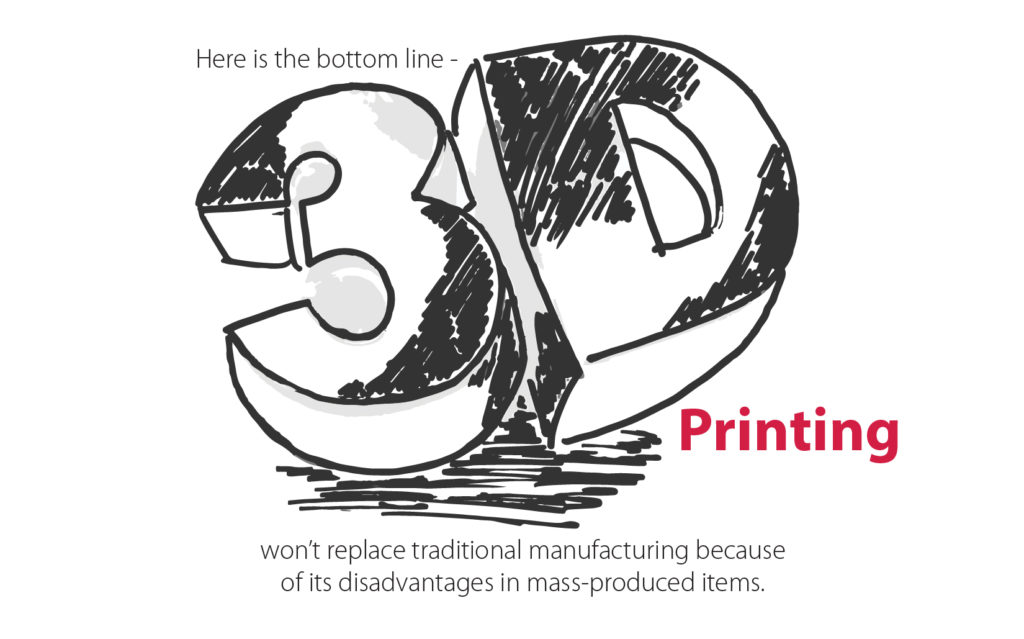
Here is the bottom line — 3D printing won’t replace traditional manufacturing because of its disadvantages in mass-produced items.
3D Printing vs. Traditional Manufacturing

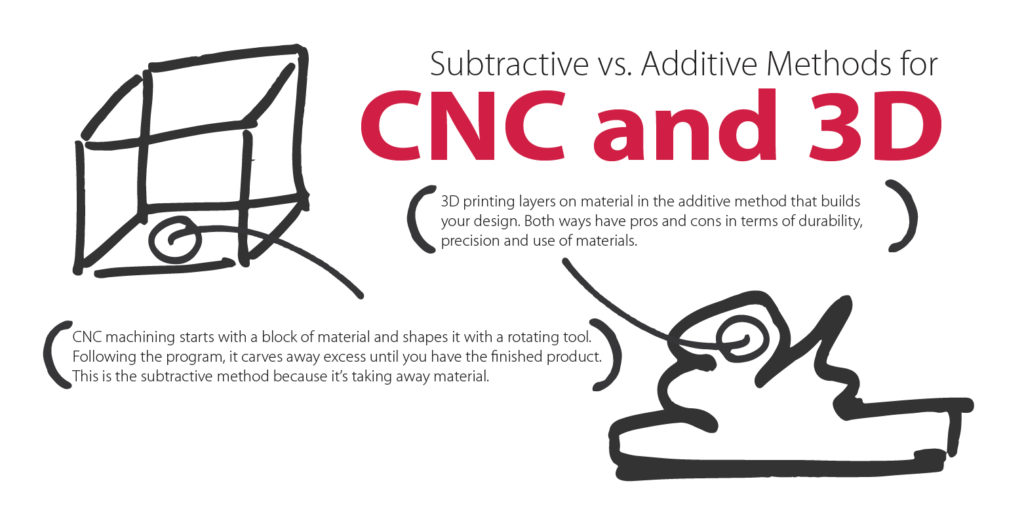
CNC machining starts with a block of material and shapes it with a rotating tool. Following the program, it carves away excess until you have the finished product. This is the subtractive method because it’s taking away material.

3D printing layers on material in the additive method that builds your design. Both ways have pros and cons in terms of durability, precision and use of materials.

Material Usage for CNC and 3D

CNC machining works with a variety of materials. They can use:

  • Metal alloys
  • Woods
  • Acrylic
  • Modeling foam
  • Thermoplastics
  • Machining wax

CNC machines have heating systems that can manage heavy materials. These materials are used to build substantial parts for engines, aircraft and other machines. They need to be exact, dependable and durable. The cutting tools for the design might have to switch, but most tools are standardized to fit any CNC machine.

3D printing doesn’t have this variety, using materials like plastics or resins. They can’t produce items strong enough to withstand intense environments like airplanes or other machinery. Also, 3D printers can’t switch between materials. Certain 3D printers are for specific kinds of material.

3D and CNC Precision of Production

CNC machining is more precise and consistent than 3D printing because they have a higher tolerance for heat. 3D printers end up with distorted products when there’s too much heat. They can offer precision but cannot remain consistent. 3D printers are often regarded as more user-friendly than CNC machines, but when they malfunction, someone has to troubleshoot them because the fault means production of unusable products.

CNC and 3D Speed of Production

CNC is a faster solution than 3D printing. Automated CNC machines can work around the clock as long as they’re properly maintained. A project that could take CNC machining an hour would equate to a 3D printer taking hours to get the final product because it has to build the product layer by layer. A 3D printer’s pace might have to slow down during the process to get the design right. Different 3D printers could also be programmed with specific speeds that you can’t alter. It depends on the machine you use.

3D printed products also require work after they’re built. The products need to be washed, polished and sealed before people can use the product. This could extend prototype testing to a longer time period with a lot of waiting in between. 3D printers are also popular for smaller, custom-manufactured items. But if you have to wait for the item to be built and still do a lot of work post-print, you lose a lot of time before you can move the product.

Versatility of Machinery for CNC vs. 3D

CNC machines can produce fixtures, tools and custom-designed parts. They have a wide range of quality settings so you can make a prototype that has a rougher design in some areas and perfect in others so you can test that part.

When testing prototypes for a project, a CNC machine could quickly build a design so the developers can test it. 3D printers don’t have these kinds of options. It will slowly shape the design as it was programmed. Accuracy is key when constructing a final product, but when time is a constraint and you want to test some prototypes, 3D printers can slow down you and your project. Designs made for a CNC machine usually can’t be substituted with a 3D printer because the products are voluminous and it would take hours for a 3D printer to finish them.

Noise and Mess Produced by CNC and 3D

These differences relate to the subtractive and additive methods. CNC machining is much more noisy and messy than 3D printing because it uses a tool to cut away material. This creates noise and a lot of scrap metal or wood shavings. CNC machines cause a lot of vibrations, so they need to be in a space where they won’t bother anyone. 3D printing only uses the material it needs for the product. There’s little to no waste, and the printers don’t vibrate like a CNC machine.
Applications for CNC and 3D

CNC machining can manufacture bigger products and can handle heat-resistance. 3D printing has more niche categories, such as printing food or working in space.

CNC Machining vs. 3D Printing

According to World Finance, 3D printing is not a solution that can replace CNC machining. 3D printing is a part of the manufacturing world, but it’s not the invention that’s going to change the market as everyone knows it.

3D printers can improve certain aspects of manufacturing but cannot handle the whole market, as CNC machining still works better in many situations. CNC machining still offers better quality than expensive 3D printers.

On a smaller production scale, 3D printers have an edge in saving businesses money from buying expensive molds. They also offer an insight to the product’s shape and aesthetic. But as production increases and time factors in, they don’t hold up as well as CNC machines.

BENEFITS OF CNC MACHINING OVER 3D PRINTING

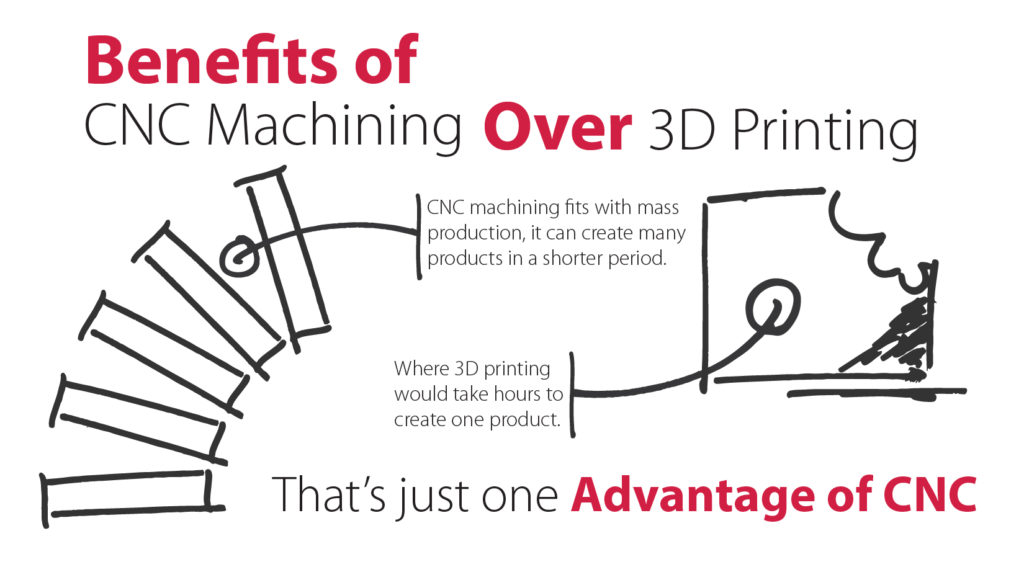
CNC machining fits with mass production. It can create many products in a shorter period, where 3D printing would take hours to create one product. That’s just one advantage of CNC. Let’s take a look at some others.

Prototyping Becomes Easier

CNC machines are better for prototypes that can withstand structural tests because they carve the design from the material. They can also build prototypes out of the exact material that will be used to make the final product.

Structural tests and alterations will be more accurate because they use the same material. This could speed up the production process because the changes will be to the design and not the material. 3D printers don’t fabricate prototypes with the structural strength, so they can’t conduct physical tests.

Prototype Integrity Improves

CNC machines don’t heat the material and reform it. The material stays stronger and has a better structural integrity than 3D printers, which have to heat the material to build the intended product. 3D printers might also have to add foreign materials to the mixture to be able to make the prototype, which CNC machines don’t need.

Surface Finish Advantage

CNC machines provide better surface finish than 3D printing because the materials don’t deform during the process. The rigid material and cutting action keeps the product together and has fewer chances for mistakes or deformations to occur. 3D printing has poorer surface finish. The material bends, warps or distorts because the material is layered heated plastic.
Tolerance Levels Rise

CNC machines work with higher precision, so the parts have a better tolerance than 3D printers. Because of tolerance level, prototypes that have shafts or connect to other parts will be higher quality and will more likely fit with other components.

Price and Volume Don’t Dictate Price

3D printing costs depend on the volume of needed materials. Final product volume doesn’t dictate the price for CNC machines. 3D printing wouldn’t be cost-effective with larger orders, and this is the situation where CNC machines thrive.

Quality in Favor of CNC

Larger layers from a 3D printer are faster but not as high-quality as smaller layers. If you need a prototype, you have a choice to get it fast but of slightly less quality, or wait longer for the prototype with the best quality the printer can provide. CNC machines have the option for you to choose resolutions for your item. They can offer varying qualities in a short amount of time, making them ideal for quick builds and immediate results for testing.

Keeping Costs Down

If you have the option of choosing which manufacturing method to use for your product, CNC machining is usually cheaper than 3D printing.

Contact  Kaito mould Works, Inc., for Your CNC Machining Needs

CNC machining can build the parts you need for your business. Our expert machinists at Kaito Mould Works, Inc., will provide outstanding work that will help you reach your goals. We aim to help you get the correct part for your project.

Kaito Mould Works, Inc., provides services for custom machine building, precision parts machine and reverse engineering of components to give you the product you need promptly. We deliver exceptional CNC machining solutions for manufacturers in multiple industries. Our skill in specialization and dedication to our work will help you and your business stay on the cutting edge of the industry. We have the solutions you need. Get in touch with us today.

If we can help you with your project please call us at 0086-769-82821468 or email sales@kaitomould.com.


Categories
Blog

WHAT IS WIRE EDM? — AN OVERVIEW OF THE EDM PROCESS

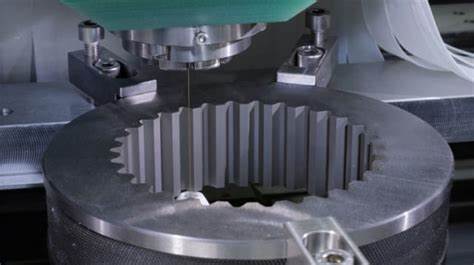
Electrical discharge machining (EDM) is a manufacturing process that implements electrical sparks to form a metal shape. Because of these sparks, EDM is also sometimes referred to as spark machining. In this process, the desired shape is cut from the metal when current discharges, or sparks, occur between two electrodes; where the sparking occurs, cuts are made into the metal, creating the desired shape and detaching it from the metal sheet.

There are two main types of EDM — wire and sinker — and several other less common methods, but this article will be focusing on wire EDM. Wire EDM uses a wire as the tool electrode. The wire is wound between two spools and, when in motion, the active part of the wire continually switches — preventing the material from eroding from the wire itself.

UNDERSTANDING THE EDM PROCESS

During the EDM process, a metal part is placed into dielectric fluid, and a wire is fed through the submerged metal component. An electric current is sent through the part to create the sparks that will ultimately help form the desired shape of the component.

When the distance separating the electrodes narrows, it increases the intensity of the electric field, and thus increases the strength of the dielectric fluid. The current more easily passes between the two electrodes under these conditions, leading to the separation of the component from the metal sheet with each spark.

After the currents have passed through and the desired shape has been achieved, manufacturers will sometimes perform a process called “flushing,” using a dielectric liquid to help remove any leftover material or waste from the finished product.

BENEFITS AND APPLICATIONS OF WIRE EDM

The wire EDM machine, also known as a “cheese cutter,” offers several unique advantages, making it a popular choice for manufacturers across a range of different industries.

EDM Benefits

Wire EDM machines are able to carefully remove excess material without exerting a strong cutting force. The process is often automated, meaning it has less chance of causing damage to the workpiece itself. And because wire EDM machines can accommodate hard materials, there is no need for secondary, post-machining thermal treatments. As a result, there is little to no heat stress placed on the shaped part, and less chance that the surface of the part will become distorted.

EDM Applications

Wire EDM is most commonly used in mold and die manufacturing processes, particularly for extrusion dies and blanking punches. EDM can be used in everything from prototypes to full production runs, and is most often used to manufacture metal components and tools. The process is best suited for applications requiring low levels of residual stress.

EDM Industries

EDM is most commonly used to manufacture parts and components for the automotive, aerospace, and electronics industries.

UNIQUE ADVANTAGES OF WORKING WITH WIRE EDM

EDM offers many unique advantages, making it the go-to machining process for producing a variety of different parts and components. First off, EDM’s high precision allows it to create very complex shapes. And its ability to work with hard materials means that it can bring those materials to close tolerances as needed.

Since EDM can handle a high level of complexity, the process can be used to create very small, intricate pieces. And with no direct contact occurring between the tool and the actual part being shaped, it’s easier to achieve a smooth surface finish that is accurate and burr-free.

And, perhaps most importantly in some instances, parts manufactured through EDM are ready for use immediately upon completion of the EDM process.

Why Use EDM?

So, why use EDM?

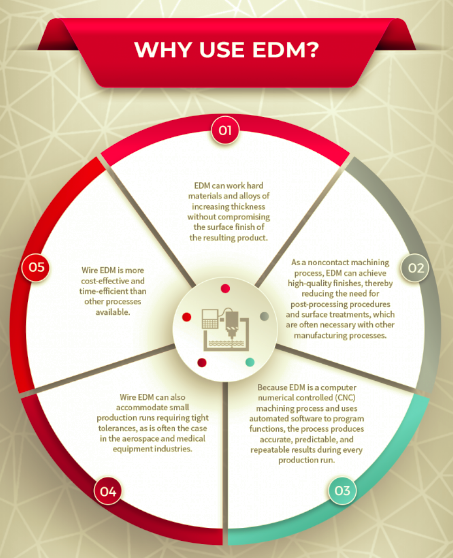
  • EDM can work hard materials and alloys of increasing thickness without compromising the surface finish of the resulting product.
  • As a noncontact machining process, EDM can achieve high-quality finishes, thereby reducing the need for post-processing procedures and surface treatments, which are often necessary with other manufacturing processes.
  • Because EDM is a computer numerical controlled (CNC) machining process and uses automated software to program functions, the process produces accurate, predictable, and repeatable results during every production run.
  • Wire EDM can also accommodate small production runs requiring tight tolerances, as is often the case in the aerospace and medical equipment industries.
  • Wire EDM is more cost-effective and time-efficient than other processes available.

Wire EDM Services at Kaito MouldWorks

Here at Kaito Mould  Works, Inc., we’re proud to specialize in custom machinery and precision parts. Our team is highly experienced in all aspects of wire EDM, and we have the in-house capabilities to perform EDM services on a wide variety of parts and components.

To learn more, check out our EDM machining page or contact the team today.

If we can help you with your project please call us at 0086-769-82821468 or email sales@kaitomould.com.
Categories
Blog

BENEFITS OF CONTRACTING CNC MACHINING

When a manufacturing business doesn’t have specific in-house CNC machining abilities, they’ll contract these tasks out to other companies to save money and time. Costs for in-house machining include expensive equipment, experienced workers, and space to house the new operation. In contrast, contract manufacturing can be done with the same level of quality and more reasonable expenditures.

In contract CNC machining, a business that specializes in efficient production of parts uses the hiring company’s designs to create the project. This frees up more of the hiring company’s time and resources to grow their business or focus on their essential manufacturing processes rather than spending time learning new equipment. Components are then labeled with the hiring company’s brand.

Many industries use contract CNC machining services for production of medical devices, electronics, parts for aerospace and defense, and packaging. The extent of the contract manufacturing can be limited to one small part or can be an entire product line.

Benefits of Contracting CNC Machining

  • Expertise: The outsourcing company does not have to start from scratch and get up to speed with production of a new part or product. They rely on experienced veterans who are accustomed to making new components with tight tolerances and exact specifications.
  • Equipment: The cost of even one CNC machine is high and may not make financial sense if it is used to produce only a few parts.
  • Ability to Scale Up: If more parts are suddenly needed due to increased industry or marketplace demand, contract machining firms are better able to take on the extra work than if the outsourcing company had to purchase new machines, train new employees, and devote more floor space to manufacturing. Outsourcing smaller runs of parts also allows the original manufacturer to focus attention on the most important parts and products that bring in the most business.
  • Quality Control: Contract CNC machining must be done to tight tolerances and meet or exceed customer expectations. Many contract companies have excellent in-house quality control and related certifications that prove their expertise. In addition, most contract firms have a range of people on staff to assist the outsourcing team with designing the most efficient and effective parts.

Circumstances to Contract CNC Machining

Some manufacturers may still be uncertain as to whether outsourcing is the best solution. Under some circumstances, contracting CNC machining work is an easy decision to make. Businesses that face the below challenges are best suited for outsourcing their work:

  • Inability to Add New Equipment: The cost, the operation, and the housing of adding new CNC machinery are all challenges to smaller and mid-sized firms that have a core business.
  • Production Range Is Narrow: Companies that specialize in one type of part may want to outsource needed components outside of this one area.
  • Schedules and Demand Changes Frequently: Some manufacturers have more seasonal demand, or the nature of their industries mean that demand fluctuates. Scaling up and down can be expensive. Outsourcing makes these changes in demand easier to manage.
  • Supply Chain Is Especially Complex: Contract manufacturing helps simplify your processes.

Any time a company’s core strengths could be diluted by adding new capabilities in-house, it is worth considering the value of contract manufacturing. Contract CNC machining benefits manufacturers of medical devices, aerospace and defense components, packing, and electronics.

Kaito Mould  Works for Your Contract Manufacturing

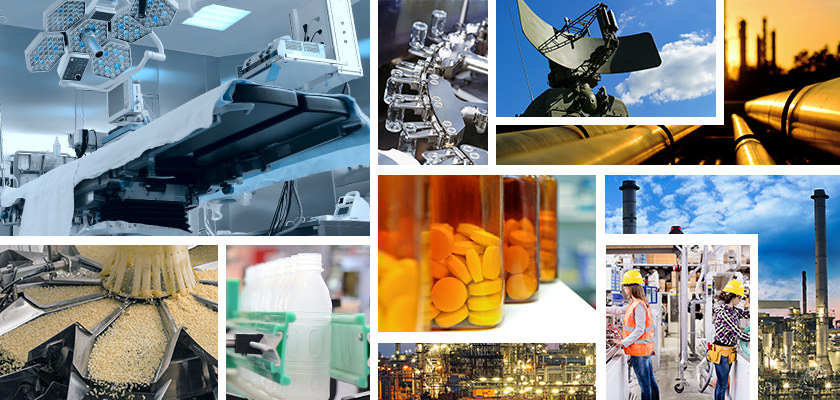
Kaito Mould Works has capacity for contract manufacturing for many industries including Medical, Pharmaceutical, Energy, Food Processing, Government/Military, Aerospace, Electronics, Telecommunications, Packaging, and Industrial.

Our contract CNC machining services include lathing, milling, and turning on multiple axis. Finishing services can be customized to produce completed parts that are ready to go. We continually invest in our machinery and utilize state-of-the-art technologies that improve efficiency and effectiveness for our customers. We are SO 9001 / AS9100 certified, ensuring the attention to quality and detail required by the industries we work with.

If we can help you with your project please call us at 0086-769-82821468 or email sales@kaitomould.com.
Categories
Blog

LOOKING FORWARD – BRING ON 2020!

To Our Valued Customers:

Each year as the calendar turns, we try to utilize this season as a time of reflection and communication with our customer base.

This is a moment for us to offer commentary on the events and accomplishments of the preceding year and to say “Thank You” for the trust and confidence that our customers place in us daily.

2019 proved to be another year of aggressive continuous improvement resulting in enhancements across the entire organization. We completed a major office expansion, allowing all nine of our project managers to come together in one collaborative environment. Our project managers act as the “inside sales” contact for our customers and with this additional space are now situated strategically for better customer service as all team members work together to facilitate projects and schedules on your behalf. We have also invested in additional large milling equipment to complement our five-axis gantry mill. Large scale machining is a service offering that has seen continuous demand causing constraints a significant percentage of the time. As a result, we have installed yet another large bridge mill with a size capacity of approximately eight feet (Y axis) by ten feet (X axis) by four feet (Z axis) to provide the additional capacity that our customers have been requesting. In addition, a host of supplementary improvements have also been made to internal processes and systems with an emphasis on high performance workflow.

We have just completed our 2020 Roadmap which represents our internal business plan and includes strategic goals and initiatives for continuous improvement for the upcoming year. Succession planning has been at the forefront at Kaito Mould Works as we strive to keep Kaito Mould  growing and thriving well into the future. As a result, our current plan involves building depth and developing additional bench strength in each department and across the entire organization. We place great value on the “people” side of our business and each year spend time and energy nurturing our culture, including our values, vision and mission to heighten employee engagement and to optimize our overall organizational health. This year will be no exception and will again bring record amounts of employee training, coaching and mentoring across our entire roster. The objective is, and always will be, to provide complete customer satisfaction by supplying products and services which meet or exceed customer requirements. Consequently, our team members are the key ingredient to making that happen on a continuous basis and therefore warrant additional investment each and every year.

As 2020 commences, we are embarking on this year from a position of strength with the wind at our backs having these enhancements fully implemented and contributing to our organization on a regular basis. Strong momentum from the previous year and a sizeable backlog help put us in an excellent position right out of the gate. We now turn our attention to the upcoming year as we consider additional areas of improvement to enrich the array of services that we can supply our expanding customer base. As always, we will be considering additional capacity increases and expanding capabilities whenever possible to better serve our clients. This year will bring many enhancements as our reinvestment plan has been set and will include many ancillary improvements such as inspection equipment, software purchases and upgrades, improvements to logistics, marketing and our overall working environment.

Regardless of the current events worldwide including trade wars, tariffs, trade agreements, geopolitical risks and regional unrest, we strive to keep our eye on the ball, which is our customer. You are our focus and have our unwavering support regardless of happenings around the world.

In conclusion, we say from our team to yours; “We look very forward to providing continued support to our existing and future customer base with this team in the upcoming year”. Thank you all for a great and memorable 2019!

We wish continued growth and prosperity to you and your organization and look forward to working with you again in 2020!

If we can help you with your project please call us at 0086-769-82821468 or email sales@kaitomould.com.

Categories
Blog

GUIDE TO MACHINING STEEL

Stainless steel offers many benefits, from an attractive finish to high strength and durability. But those come at a cost for the machine and its operator. Steel can be a formidable opponent due to its strength and durability, but those features are what make it so useful in the first place. Between alloys, speeds and tool selection, many aspects will affect your final product and the process by which you create it.

Machining steel parts takes a certain level of preparedness and understanding of the materials you’re working with. Below are some of our tips for machining steel.

MACHINING PROCESS FOR STEEL

When machining stainless steel, you’ll have to take into consideration all of its characteristics. Remember that it is strong, even at high temperatures.

1. Endmills

The tools you use will have a major impact on your project and the damage it can cause to your machine. The ideal type of endmill varies by application, but be sure to stick with a high-speed steel or carbide-constructed tool. High-speed steels include tungsten and molybdenum. Cemented carbides are a good choice when you need higher feeds or speeds. Make sure the cutting tool is sharp and in good condition to keep a high quality of cut.

  • Roughing: An endmill with 4-5 flutes can offer sufficient roughing on steel. Remember that higher flutes make room for higher feed rates.
  • Slotting: To slot steel, you’ll have to be aware of chip control and take enough care so your tools aren’t chewed up and your finish isn’t ruined. Try a four-flute endmill, which allows for chips to leave the cutting area more efficiently.
  • Finishing: To finish steel parts, you’ll want a large number of flutes or high helix of over 40 degrees.

2. Feeds and Speeds

Now that you have the right tool selected, you need to ensure your speeds are appropriate. While it takes a little fine-tuning, a good starting point would be between 100 and 300 surface feet per minute (SFM) with chiploads ranging depending on the tool size.

STEEL MACHINING TIPS

Steel can be tricky to machine, but it’s not too bad if you are prepared and use the right settings and tools. Be sure to keep these concepts in mind as you machine steel.

  • Keep heat low: Steel machining can generate very high temperatures, so take precautions to minimize their effects. Be sure to use a cutting fluid. Between work hardening and low thermal conductivity, keeping heat away from the cutting area is important to keep it in top shape. If excessive heat remains here, you may see distortion and a reduction in corrosion resistance. Cutting fluids help provide lubrication to wash away any chips, lower the wear on your tools and cool the endmill down. Common cutting fluids include mineral oils and emulsifiable oils. Make sure that you have plenty to use because any interruption of the coolant can lead to fluctuations in temperature, which can affect tool life.
  • Avoid work hardening: Many steels have high work hardening tendencies. Make sure your tools are sharp and try to keep it moving to avoid any lulls in the cutting process that would lead to a buildup of heat.
  • Control vibration: The strength of stainless steel and the speed it requires from the tool can cause extensive vibrations. Vibrations on your work surface can damage your finish while adding wear to your tool. You’ll need a robust, rigid tool capable of high-speed cuttings. Keep your workpiece firmly in place with clamps and minimize any tool overhang. You can also try using tools with a small nose radius.
  • Know your material: Every steel alloy is a little different. Know the properties of the one you’re using so you can better adjust your machine to address its characteristics. The addition of sulfur, for instance, can allow for higher feeds by affecting the hardening of chips and helping the tool edge stay consistent. Lead allows for higher speeds since it provides a lubricating property that keeps the heat down.

HOW IS MACHINING STEEL DIFFERENT THAN OTHER MATERIALS?

When machining steel, you’re not working with just one element. Steel is an alloy, comprised of carbon and iron, though other elements are often added to impart specific properties on the metals. This means that different types of steel are going to behave in different ways, and you have a lot of options. According to the World Steel Association, there are over 3,500 different grades of steel.

When machining steel, you're not working with just one element.

Alloys tend to have added strength from the inclusion of elements like nickel, chromium and copper. They may also improve its corrosion resistance, strength, ductility and ease of machining. Stainless steels use a larger amount of chromium to offer corrosion resistance. Some types of steel are even designed for easier machinability.

As for other metals, here is a breakdown of some of the more common options.

  • Aluminum: In terms of machining steel vs. aluminum, the primary benefit of aluminum is that it is much lighter than steel. Aluminum also allows for faster machining, but it lacks the hardness and strength that steel has.
  • Titanium: Titanium is one of the strongest metals out there, even in extreme or fluctuating temperatures. Plus, it has a low weight. The biggest trade-off is the cost of titanium, which is typically considerably higher than that of steel. Titanium is often chosen for sensitive applications like those in aerospace and defense.

COMMON STEEL MACHINING APPLICATIONS

Steel has a lot going for it in terms of strength and durability, but the biggest drawback is its weight. It typically is reserved for applications where weight isn’t much of a concern. This often includes structural components. Infrastructure like railways, buildings and roads commonly use steel. Other pieces like screws and bolts may also be made of steel. You can find it in industries like mining, shipbuilding and aerospace technology.

You may find stainless steel in even more places due to its attractive finish. It is versatile and common in furniture and appliances. The corrosion resistance of stainless steel also helps in these applications.

BOOST YOUR STEEL MACHINING PROCESS

Boost Your Steel Machining Process.

Whatever the application, the proper approach can make all the difference in your steel machining process. If you adopt high-quality tools and efficient practices, steel doesn’t need to be a tough opponent. Make things easier for your machine operators and minimize expenses associated with quickly worn tools and ruined workpieces.

Contact the experts at Kaito Mould Works for more information on how you can improve your steel machining process today. With over 35 years of experience, we’ve got the knowledge and knowhow to bring your machining capabilities to the next level.

If we can help you with your project please call us at 0086-769-82821468 or email sales@kaitomould.com.
Categories
Industries

PACKAGING MACHINE FABRICATION

Packaging machine components endure unbelievable wear and tear, and packaging machine manufacturers know this all too well. At Kaito Mould Works, Inc., we understand that when a business contacts us with a broken part or piece of packaging equipment, time is money. We have the in-house experience to take your packaging needs and ideas from the concept and design phase all the way to their full fabrication and installation.

To sell successfully, today’s consumer goods rely heavily on the appropriate packaging. It’s not just about sealing in quality and freshness or containing complex and irregularly sized products — it’s also about how these goods can best be transported and displayed. Naturally, both material and labor costs are important factors when companies decide on the method and style for packaging their consumer goods.

Whether you need to repair an existing piece of packaging equipment and only have the broken part or you have to decide how to incorporate a piece of packaging equipment into your production line, you deserve to work with a packing machine fabricator that possesses the know-how to deliver top quality and maximum value.

That’s why working with Kaito Mould Works is the smartest choice you can make. We have a 5000-square-foot, world-class facility with state-of-the-art equipment as well as a three-decades-long list of satisfied clients.

CNC PACKAGING MACHINE MANUFACTURING

Your customer base won’t wait if your distribution goes down because of faulty packaging equipment. So how do you get the results you’re looking for consistently and within your budget? The answer is simple: Work exclusively with a packaging machine manufacturer that’s certified in everything from reverse-engineering to computer numeric control (CNC) machining.

At Kaito Mould Works, we’ve been refining our CNC machining capabilities for well over 30 years. In addition, with full reverse-engineering services from our best-in-class, highly trained engineers and machinists, we can extract all the design information necessary to produce repeatable replacement parts for any broken piece of equipment you have, as well as generate a CAD model for future reference.

Whatever your packaging needs are — from shrink-wrap packaging and bundling to clamshell packaging and pallet containment — you want reliable service on everything from getting a quote to agreeing on an installation and testing timeline. Once again, this is why working with Kaito Mould Works can benefit your business and help protect your bottom line.

Certified Quality and Craftsmanship

As a member of the Manufacturers’ Association, with a fully certified quality management system in accordance with AS9100D and ISO 9001:2015, Kaito Mould Works has the experience and track record you want in a one-stop packaging machine manufacturer. You can rest assured that all of our equipment manufacturing, assembly, repair and technical support follows the strictest quality and industry standards.

In addition to filling your most complex and custom orders, we’re dedicated to delivering value and top-notch customer service. Plus, you’ll have the confidence that only comes from employing a certified ISO 9001 and AS9100 American small business with an accredited A+ Better Business Bureau rating.

If we can help you with your project please call us at 0086-769-82821468 or email sales@kaitomould.com.

Categories
Industries

Industrial Equipment

Kaito Mould Works is pleased to provide CNC precision machining, custom machine building, reverse engineering, five-axis machining and milling and a host of other machine services to companies across a broad spectrum of industries. With more than 30 years of machining experience, you can trust us to deliver consistent results for every project. Whether yours is a small start-up business or a multinational Fortune 500 organization, you will experience the world-class quality, service and support that have been the hallmark of our company since 1984.

Medical Industry Precision Machining

As one of the world’s leading medical machining companies, we can provide precision medical machining for implants, surgical instrumentation and other medical devices for specialties such as orthopedics, cardiovascular and ophthalmology. Our machining capabilities include materials commonly used in medical device manufacturing such as titanium, tungsten chrome, stainless steel and many others. We recognize the importance these devices have in the lives of patients. Whether we’re performing custom CNC lathe machining for medical equipment parts or any other machining service, we pay attention to every detail to ensure the highest quality for the finished component.

Pharmaceutical Equipment Manufacturing

Kaito Mould Works is one of the most respected pharmaceutical machinery manufacturers in the U.S. Our advanced custom machine building services enable us to produce high-quality machinery that meets the precise requirements of pharmaceutical production operations. Our services also include machining of components and parts, secondary services such as anodizing and electroplating, comprehensive mechanical assembly and hydraulic system plumbing. While other pharmaceutical equipment manufacturers can perform custom machine building, few can match our combination of experience, knowledge and customer commitment.

Energy

Energy is one of the fastest-evolving industries in the U.S. and around the world. Consequently, energy companies must continually focus on innovation just to keep pace. Our capabilities include responsive CNC machining services that are tailored to the unique manufacturing requirements of energy industry companies of all types and sizes. Whether you’re involved in the gas, oil or electric industry or renewable energy applications such as solar panel or wind turbine manufacturing, we can work with you to produce the custom parts and components you need for your equipment.

Food Processing Equipment Design & Manufacturing

Food processing equipment must be manufactured to the highest quality and sanitation standards. Our premium machining services for food processing applications include five-axis machining and milling that provides the pinpoint precision required when manufacturing parts and components for this highly specialized industry. The five-axis machining process also results in shorter lead times to help you maintain your tight production schedules. We have extensive experience working with commonly used food-processing industry materials such as aluminum, titanium, stainless steel and various steel alloys.

Government Machining Contracts

Kaito Mould Works has accumulated a solid portfolio of government machining contracts – we’ve entered into thousands of contracts with various government entities over the years. We understand the highly precise specifications and standards that apply when performing work for government and military operations. We’re proud of the machining services we’ve provided to numerous government agencies as well as the United States Army, Navy and Coast Guard.

Aerospace Parts & Equipment Manufacturing

The aerospace industry relies on highly complex parts when manufacturing aircraft and related equipment. Our services consist of custom machining of aerospace components, including electrical discharge machining (EDM). We also provide the best CNC lathe machining of aerospace parts in the industry. We can produce high-quality parts that meet the accuracy, efficiency and repeatability standards that are essential in aerospace manufacturing applications.

Electronics/Semiconductor Manufacturing

Electronics industry manufacturing applications often require the use of small, irregularly shaped parts and components. We’re experts at the machining of electronics industry products such as semiconductors, housings, PCB, test fixtures, connectors, heat sinks and more. We can also perform milling of commonly used electronics materials including copper, aluminum and many others.

Telecommunications Equipment Manufacturing

Telecommunications is another industry where changes seem to occur at the speed of light. Telecommunications industry manufacturers must be able to design and produce new parts and components as quickly as possible to maintain their competitive advantage. The Kaito Mould Works team includes experienced machinists, engineers, CNC operators and other capable professionals who understand the importance of high-precision turning and milling when helping our customers meet the demands of today’s fast-paced telecommunications manufacturing environments.

Packaging Machine Fabrication

The numerous types of packaging used for consumer goods and other products often require the manufacturing of custom machinery. With our fast, reliable custom machine-building services, we can produce the ideal packaging machine for your specific applications. Our expert engineers, designers and machinists will work with you to incorporate your packaging needs into a fully functioning design that will get the job done. We also have the production facilities to bring your packaging design concept to life as quickly as possible to meet the demands of your customer base.

General Manufacturing

Our facility in Dongguan, China can handle any type of conventional manufacturing application. Whether you need high-quality CNC machined parts, five-axis machining and milling to create complex or complex parts, reverse engineering to produce high-performance OEM replacement parts that are no longer available or difficult to find, or reliable welding and manufacturing services And we can deliver results that exceed your expectations.

Why Choose Kaito Mould Works for Your Machining Services?

Kaito Mould Works has a successful track record of delivering superior results for companies in every industry we serve. Our ongoing investment in facilities, equipment, technology and people ensures we will continue to provide innovative, responsive machining services to our customer base. By adhering to our core values of quality, integrity, teamwork, innovation, commitment, respect and compassion, we will remain one of the leading machining service providers for many years to come.

Contact Us to Learn More About Our Machining Services

Discover what makes Kaito Mould Works your best choice for high-quality machine services – regardless of the size or type of your company or your industry. Contact us for more information today.

Categories
Industries

Automotive

The automotive industry is evolving fast. As industry trends like autonomous driving, on-board connectivity, and hybrid/electric vehicles continue to drive innovation, agility-minded automotive companies are turning to Protolabs to accelerate new product development and get to market faster. With quick-turn digital manufacturing and automated manufacturability feedback, designers and engineers can mitigate design and cost risks while developing a more responsive supply chain to better react to driver and passenger demand for more customized vehicles.


Why kaitomould  for Automotive Development?

Rapid Prototyping

Mitigate design risk through rapid iteration and prototyping in production materials without sacrificing development speed.

Supply Chain Flexibility

Get on-demand support for line-down emergencies, part recalls, or other supply chain disturbances in your production plants by using automated quoting, rapid tooling, and low-volume production parts.

Quality Inspections

Validate part geometry with several quality documentation options. Digital inspection, PPAP, and FAI reporting are available.

automotive

Mass Customization

Implement low-volume manufacturing to enable more diverse and customized automotive features that are tailored to modern drivers.

Tooling and Fixtures

Improve manufacturing processes to create greater automation and streamlined component assembly with custom fixturing.


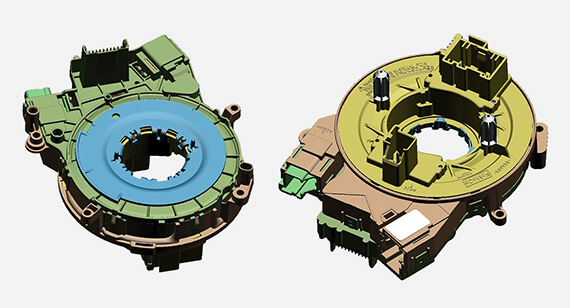
automotive-electronicThe renderings show top and bottom views of ZF’s intricate clock spring assembly.
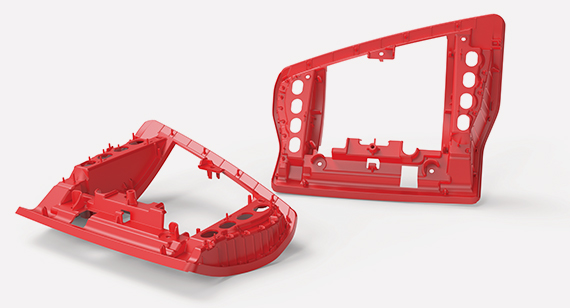
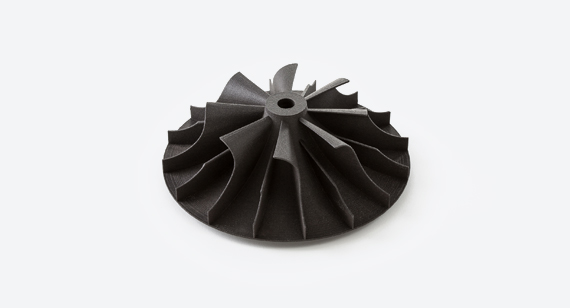
A Front Seat on Driving Innovation with ZF

Steering column control modules now integrate an expanding variety of functions into the steering wheel, offering drivers a host of functions for both safety and convenience. Providing connectivity between all of those helpful buttons and switches and the functions they control—from the turn signals and wipers to cruise control and even heating the steering wheel itself—is the job of the clock spring, a plastic disc about the size of a hockey puck that sits hidden under the steering wheel within the steering column control module. See how digital manufacturing helped reduce product development time for global tech companies Kaito Mould.

What Materials Work Best for Automotive Applications?

pl-industry-automotive
Thermoplastics. Choose from hundreds of thermoplastics including PEEK, acetal, or supply your own material. Maintain branding with custom colorants for qualified projects.
nylon-materials-turbine
Nylons. 3D print functional prototypes in several nylon materials available through selective laser sintering and Multi Jet Fusion. Mineral- and glass-filled nylons improve mechanical properties when needed.
lsr-marterials
Liquid Silicone Rubber. Silicone rubber materials such as fuel-resistant fluorosilicone can be used for gaskets, seals, and tubing. An optical clarity silicone rubber is also available for lens and lighting applications.
dmls-automotive-part
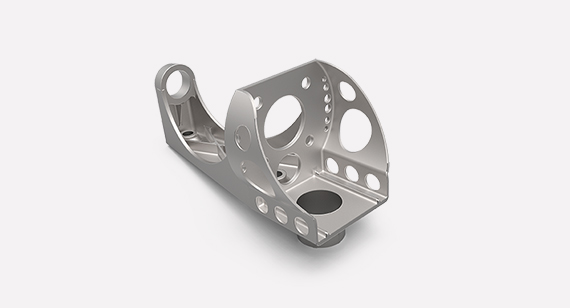
Aluminum. This all-purpose metal used for light-weighting provides excellent strength-to-weight ratio and can be machined or 3D printed.

COMMON AUTOMOTIVE APPLICATIONS

Our digital manufacturing capabilities accelerate the development of a range of metal and plastic automotive components. A few of common automotive applications include:

  • Assembly line components
  • Fixtures
  • Enclosures and housings
  • Plastic dash components
  • Aftermarket parts
  • Armatures
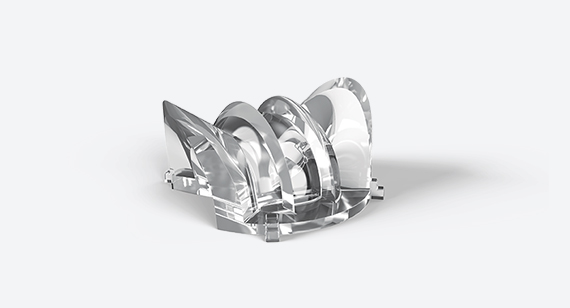
  • Lenses and lighting features
  • Support for on-board consumer electronics
Categories
Industries

Consumer Electronics

Development speed and a well-designed, user-centric final product are critical to the success of companies launching consumer and computer electronic products and devices to different markets. Technology-enabled manufacturing processes can accelerate design cycles, lower development costs, and help support more SKUs and product customization that consumers now demand. From airplanes to automobiles to hospitals, electronics can be found nearly everywhere delivering value through advanced features and improving user experiences.


Why kaitomould  for Development of Consumer and Computer Electronic Components?

Automated Quoting

Save days or weeks of development time with automated quoting and design feedback within hours, oftentimes faster.

Rapid Injection Molding

Quickly scale from prototyping to low-volume production and be first to market with quick-turn plastic injection molding, overmolding, and insert molding.

pl-ind-icon-black-consumer-electronics

Functional Prototyping

Quickly iterate and improve early designs with 3D-printed or machined prototypes made in production materials.

Mass Customization

Leverage low-volume production capabilities to offer more customization options that customers demand.

Onshoring

Simplify your supply chain with a domestic manufacturing partner that can produce functional, end-use parts within days and provide a bridge to production.


hp-frame-component

HP Slashes Design Cycle Time with Rapid Manufacturing

The tech giant used injection molding to trim development time from months to weeks for its next-generation printers. While developing its next-generation inkjet printer, HP turned to Protolabs’ injection molding service to slash design cycle time from a standard, six- to eight-week timeframe to just 15 days.

What Materials Work Best for Consumer and Computer Electronic Components?

pl-cons-elect-sheet-metal
ABS. This reliable thermoplastic is widely used in industries like consumer electronics. It brings general-purpose performance for parts like electronics enclosures and handheld devices and is also relatively inexpensive.
sheet-metal-casing
Aluminum.This material can be machined or formed through sheet metal fabrication to create housings, brackets, or other metal parts that need high strength and low weight are required.
pl-cons-elect-om
Elastomers. Available in both 3D printing and injection molding, choose from several elastomeric materials for parts that need impact resistance or flexibility. Overmolding is also available for components and products with ergonomic grips, buttons, or handles.
polycarbonate
Polycarbonate. This strong and extremely impact resistant thermoplastic has a low shrink and good dimensional stability. It’s a transparent plastic that is available in optically clear grades, which works well for transparent covers and housings.

COMMON APPLICATIONS

We have several capabilities within our services and processes catered to the consumer and computer electronics industries. A few common applications include:

  • Housings
  • Fixtures
  • Consoles
  • Heat sinks
  • Knobs
  • Handles
  • Lenses
  • Buttons
  • Switches
Categories
Industries

Aerospace & Defense

When it comes to aerospace equipment manufacturing, the production of any part used in the aerospace industry calls for the highest-quality product and strictest adherence to standards. At Kaito Mould Works, Inc., we’ve been producing complex and custom equipment for over thirty years. We know from decades of experience what type of exacting standards must be met to successfully produce machine parts for aircraft and spacecraft.

In addition, we understand the tight turnaround times and budget pressures aerospace organizations deal with. That’s why numerous organizations trust us to not just get it right, but to get it right on time and within budget.

MANUFACTURING STANDARDS FOR THE AEROSPACE INDUSTRY

Aerospace standards cover a host of processes, from material handling to manufacturing procedures. This is understandable, considering that equipment costs, performance expectations and safety concerns are all factors that contribute to some of the strictest technical and product regulations of any industry today.

To meet these standards with confidence, Kaito Mould  Works has put into place a certified quality management system in accordance with AS9100D and ISO 9001:2015. Moreover, our accreditation is in accordance with the International Aerospace Quality Group Industry Controlled Other Party Management System. This means that all of our manufacturing, assembly, repair and engineering support of mechanical and electromechanical products follows the highest quality and industry standards.

CNC Machining for Aerospace Parts

When lives and performance are on the line, every part and piece of equipment must be manufactured appropriately. The manufacturing process should also be repeatable whenever necessary. For this reason, we continually offer computer numeric control (CNC) machining to the aerospace industry. Ever since the late 1960s, this automated process has been used in the precision machining of high-performance parts and equipment. And at Kaito Mould Works, we’ve been honing our use of CNC aerospace machining for well over three decades.

In addition to the most respected CNC lathe machining in the industry, our highly experienced machinists, engineers and project managers also provide electrical discharge machining (EDM), 5-axis machining and milling, and panel wiring and control systems — to name a few of our many services.

Complex Orders Filled Effortlessly

Our ability to custom machine almost any aerospace part or piece of equipment is matched only by our experience in working with traditional and non-traditional materials. From aluminum and titanium to heat-resistant plastics and exotic alloys, we can make the part you need with full confidence.

In addition to filling the most complex orders, at Kaito Mould Works, we deliver value and know-how every day. You can rest assured that you’re employing a certified ISO 9001 and AS9100 small business with experienced customer service representatives who are all dedicated to your satisfaction.

We encourage you to conta us and learn more about our world-class facility in Ephrata, PA, which was specifically constructed for the streamlined manufacturing of high-quality parts and equipment.

Remember: When you have the need for affordable, dependable and efficient machining services, you need Kaito Mould Works on board.

Categories
Industries

Medical

Kaito international CO Ltd. is proud to be a global leader in the medical device manufacturing industry. For over 30 years, we’ve been providing fast, accurate and affordable medical devices, tools, parts and equipment. In an industry with some of the strictest requirements and tightest turnaround times, we never forget the people and companies whose well-being depends on us filling their orders correctly, efficiently and cost-effectively.

CNC MACHINING FOR MEDICAL INDUSTRY NEEDS